
Why your AI content strategy may be backfiring...
AI has made content nearly free to produce, so the natural response is to produce more of it: run a prompt audit, find the hundreds of queries where competitors surface and you don't, and generate a page for each. It feels like progress. It's the single most damaging habit most companies have right now.
Google does not ban AI content. But it does discount low-value pages made at scale, and that assessment can spread across your whole domain. A site full of generic posts reads as what it is: a cheap attempt to catch traffic.
The cost compounds. Every thin page dilutes the topical authority of your strongest ones. It spreads crawl budget and internal links across URLs that will never rank. And it trains both Google and the LLMs to treat your domain as a content mill rather than a trusted source. Call it authority debt: cheap to take on, expensive to pay down.
Meanwhile the upside rarely arrives. Retrieval systems don't reward volume, they surface passages backed by demonstrable expertise and corroborated across the wider web. So you trade weaker SEO and a diluted brand for almost no gain in AI visibility.
The takeaway isn't "stop using AI to write." It's to stop treating volume as a strategy and start treating every page you publish as a claim your domain has to stand behind.
AI visibility and SEO can work together, but it's not easy
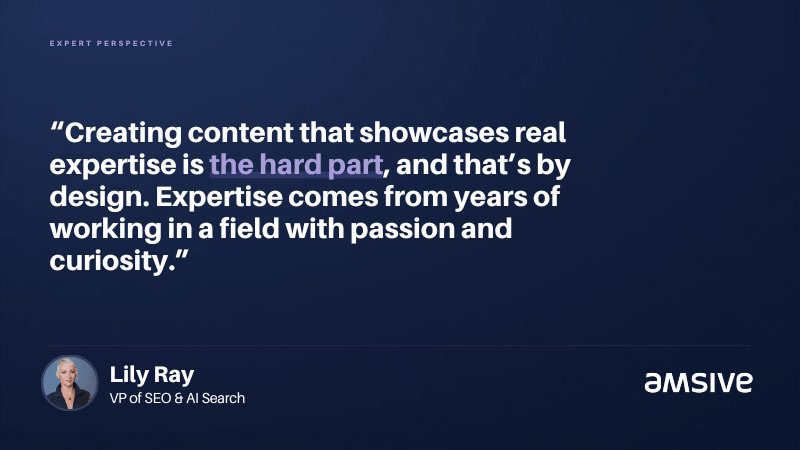
“Creating content that showcases real expertise is the hard part, and that’s by design,” says Lily Ray, Founder of Algorythmic and VP of SEO & AI Search at Amsive. “Expertise comes from years of working in a field with passion and curiosity. The best way to demonstrate that expertise is building a personal brand and consistently publishing content that gets others thinking.”
Indeed, balancing AEO and SEO optimization requires a different type of discipline. Broaden your SEO base. Do not flood your site with AI posts merely because a prompt audit found gaps. Test ideas before you publish. Build presence in the sources AI systems cite. Create content that shows real expertise. AI has made average content cheap. That makes judgment more valuable.
A better approach is to use an LLM simulator to evaluate which of these hundreds of content ideas are likely to inform AI answers. At Bodhium Labs, we encourage our clients to “Know before you execute.” We use AI interpretability techniques to understand why you are missing in AI answers and to test which content changes are likely to improve AI visibility. The answer may sometimes be “write a new blog post.” But it may be “update the main product page with this information,” “fix outdated claims,” “fix your Wikipedia entry,” or “make a better comparison page.”
This shifts the work from volume to judgment. Publish fewer things. Make them count.
More questions? Contact us at marketing@bodhiumlabs.com.